
Let’s be honest: most golfers treat range time like an all-you-can-eat buffet. They grab a bucket of 150 balls, pull out the driver, and start flailing away at max speed until their back hurts and their slice gets even wider. That isn’t practice, that’s just expensive cardio with a golf club.

I’m Coach Jeff Ponce, and my goal is to save you from wasting good simulator time. Indoor bays equipped with tour-grade technology like RangeX and Foresight GCQuad give you feedback that outdoor grass ranges simply can’t match—provided you actually know how to use it.
Need a refresher on the math? If terms like Smash Factor or Face-to-Path sound like dynamic physics homework, check out Coach Daniel’s guide on Golf Launch Monitor Numbers Explained before reading further.
1. Stop “Raking and Hitting”: The 60-Minute Blueprint
If you hit a ball every 8 seconds, your brain has zero time to process what just happened. Here is how to structure a 60-minute session so your swing actually improves by next weekend:
00:00 – 00:10 | The “Wake Up Your Muscles” Warm-Up
No drivers allowed yet. Start with a pitching wedge, swinging at 50% effort. Focus on solid contact, clean posture, and getting your body moving. You’re trying to play golf, not strain a back muscle.
00:10 – 00:30 | Technical Block Practice (Fix ONE Thing)
Pick a single parameter to improve—like start-line Face Angle or Smash Factor. Use the RangeX dual cameras to check your video replay after every single swing. If what you felt didn’t match what you saw on screen, make an adjustment before hitting the next ball.
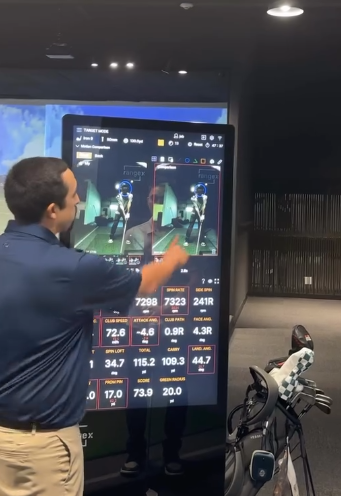
00:30 – 00:50 | Random Target Practice (Real Golf Simulation)
Now put away the mechanical thoughts. Pick a new club and a new target on every single shot: 7-iron to 160 yards, then driver down a tight fairway, then 54° wedge to 80 yards. Step off the mat and execute your full pre-shot routine every time.
00:50 – 01:00 | The Pressure Challenge
Finish with a competitive game against yourself. Try hitting 5 consecutive fairways within a 30-yard target zone. If you miss on shot #4, you start over at zero. Feel that slight heartbeat spike? That’s what first-tee jitters feel like.
2. Two Essential Drills That Actually Translate to Grass
Drill #1: The Wedge Yardage Dial
Stop guessing if a 60-yard shot is a “hard pitch” or a “soft half-swing.”
- Hit 5 balls using your 56° or 58° wedge with hands stopping at lead-arm parallel (9 o’clock position).
- Look at your average Carry Distance (ignore total distance with roll).
- Write that number down. Congratulations, you just built a dependable scoring wedge you can trust when there’s water behind the green.

Drill #2: The Face-Angle Gate
Remember: Face Angle dictates roughly 85% of where your ball starts traveling.
- Take your mid-iron and make 10 swings.
- Your goal is to keep your Face Angle metric within
±1.5°relative to target. - If you see a Face Angle of
+4.2° Open, don’t just swing harder on the next one—check your grip pressure and clubface rotation at release.
3. Coach Jeff’s Golden Rules for Indoor Success
- Carry Number Is King: Total distance includes simulated roll that might not match soggy turf on a Sunday morning. Base your club selection on Carry Distance.
- Step Off the Mat: If you stay glued in your setup stance for 10 shots in a row, you’re training a habit you can never repeat on a real golf course.
- Get an Eyeball Check: Technology tells you what the ball did; a coach tells you why your body did it. Combine simulator sessions with occasional coaching to keep moving in the right direction.